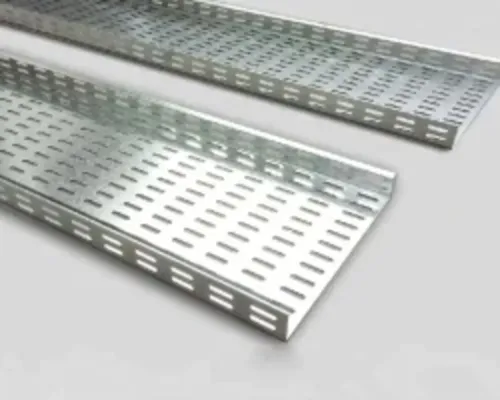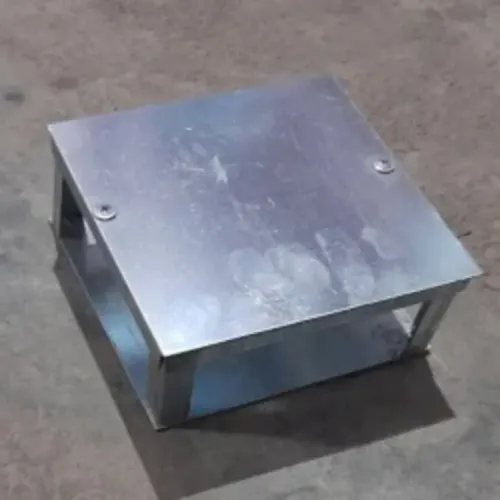
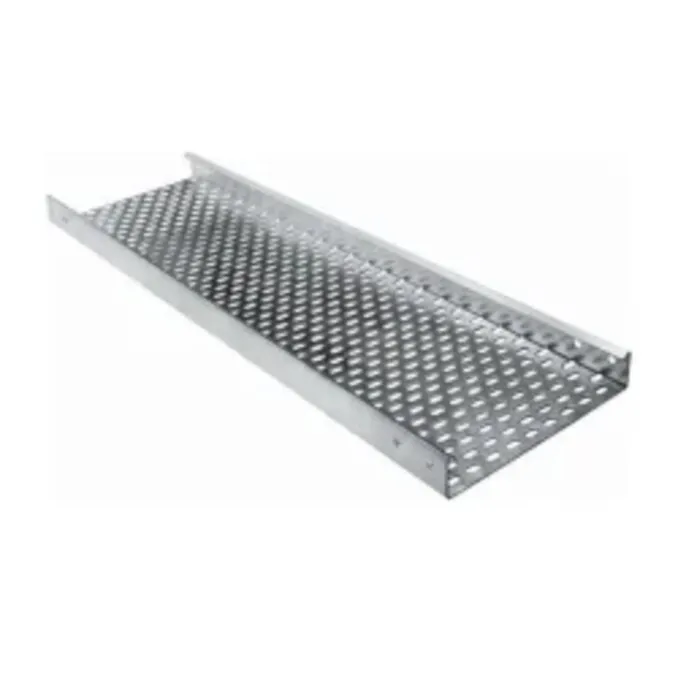
Rainwater, condensation, mud and blocked drainage can keep a mild-steel tray wet long enough to attack cut edges, fasteners and joints before the main surface shows damage. By the end, you will be able to choose a coating, specify drainage and covers, inspect delivered material, and define repairs for an MS tray exposed to Bengaluru’s monsoon conditions.
Key takeaways
- Specify hot-dip galvanizing, coating thickness and repair requirements in the purchase order.
- Use tray slopes, drainage gaps and covers that shed water without trapping condensation.
- Seal field cuts and inspect joints, fasteners and low points after heavy rain.
- Reject bare mild steel for exposed Bengaluru installations unless a documented protection system applies.
How Bengaluru monsoon exposure changes the tray specification
Choose the tray by wetting, not by annual rainfall. For an ms electrical cable tray for protection during monsoon in bengaluru, bare mild steel is unsuitable outdoors because repeated wetting, condensation, mud and standing water accelerate rust at joints, edges and low points.
| Exposure location | Suitable MS tray specification | Reason |
|---|---|---|
| Dry indoor plant room | Pre-galvanized steel, if condensation and wash-down are absent | Atmospheric moisture is limited, so factory zinc protection can be sufficient |
| Indoor area with condensation | Hot-dip galvanized after fabrication | Zinc protects drilled edges, welds and formed surfaces better than pre-galvanized sheet |
| Covered outdoor route | Hot-dip galvanized after fabrication, with a correctly fitted cover | The roof reduces direct rain but does not prevent humid air, wind-driven spray or condensation |
| Open outdoor route | Hot-dip galvanized after fabrication, with drainage and a cover | Direct rain and debris demand a continuous, durable zinc coating |
| Cooling tower, roof-drain discharge or splash zone | Hot-dip galvanized after fabrication; add a project-approved duplex zinc-and-paint system when exposure assessment requires it | Persistent wetting and contaminated splash attack coatings faster than normal rainfall |
Painted or powder-coated MS is not automatically equivalent to galvanizing; damage exposes steel and creates rust creep beneath the coating. Route trays away from discharge points where possible. Do not label every Bengaluru site C5: traffic pollutants, sewage, industrial emissions, salinity and wetness determine the corrosivity class.
A cover shields cable from rain, but it does not turn the tray into a watertight enclosure.
What galvanizing and coating details must appear in the purchase order
Bare mild steel is not a corrosion-protection system. For MS electrical cable tray monsoon protection, the purchase order must identify the coating process, coating quantity, repair method and acceptance evidence—not merely say “weatherproof.”
1. Specify hot-dip galvanizing after fabrication, not only pre-galvanized sheet. Name the governing standard, such as ISO 1461 or ASTM A123, and state the required local coating thickness or coating mass for the specified steel thickness.
2. State how compliance will be accepted: galvanizing certificate, batch identification, coating-thickness readings, visual inspection and a repair record for rejected areas. Ask for readings taken on tray bodies, covers, bends and fittings.
3. Require complete coverage inside and outside, including welds, edges, holes and fabricated corners. A pre-galvanized tray with newly drilled holes has exposed steel unless every cut edge receives the specified repair.
4. Define field-damage repair: remove oil, rust, loose zinc and weld residue, then apply a compatible zinc-rich repair coating to the manufacturer’s stated dry-film thickness. Ordinary enamel paint does not restore sacrificial zinc protection.
5. If paint or powder coating is proposed, name the primer, topcoat, colour, surface preparation and dry-film thickness. For a duplex system, require the zinc coating underneath and a documented compatibility procedure.
6. Specify hot-dip-galvanized or otherwise project-approved corrosion-resistant fasteners, plus coating certificates that identify the supplied tray batch and fittings. Reject vague wording such as “anti-corrosion finish.”
How tray layout and covers stop water from being trapped
Give the route a deliberate fall wherever the installation permits, with no sag between supports or at changes in direction. Place supports close enough to maintain the selected tray’s allowable deflection, and add support at bends, risers and cover transitions so the tray cannot settle into a water-holding low point.
- Route the tray away from roof-drain outlets, cooling-tower discharge and persistent splash zones.
- Keep factory drainage holes open and add approved drainage openings only where the system design permits.
- Do not seal both tray ends or create closed pockets at reducers, tees and vertical transitions.
- Maintain clearance below the tray so water dripping from its underside can escape and inspection remains possible.
Use covers to shed direct rain and falling debris, not to create a watertight box. Select a sloped, overlapping or rain-shedding cover suited to the tray geometry and wind exposure, then secure it against uplift without blocking drainage paths. A flat cover that traps condensate at its edges accelerates corrosion at joints and fasteners.
Check the combined effect of cable weight, cover weight, standing water and wind uplift against the manufacturer’s IEC 61537 or NEMA VE 1 design data. Covers also reduce heat dissipation, so confirm the cable current rating separately.
This is essential for industrial cable tray weather protection in bengaluru, where repeated wetting and humid air extend drying time.
How to protect and inspect joints, field cuts and fasteners
Joints, field cuts, drilled holes, ground welds and fasteners need the closest protection because they are the first places for Bengaluru rainwater to reach steel. A bare mild-steel edge is not protected; clean it of oil, rust and loose zinc products, then apply a compatible zinc-rich repair coating.
Ordinary enamel paint does not restore sacrificial zinc protection.
| Detail | Defect to find at delivery or installation | Required response |
|---|---|---|
| Joint plates and couplers | Missing bolts, loose hardware, mismatched finishes or a gap that traps mud | Fit the specified hardware, tighten it, and keep the joint draining |
| Field cuts and drilled holes | Bright bare steel, burrs, rust staining or unsealed holes | Deburr, clean and repair with the approved zinc-rich coating |
| Ground welds and scratched areas | Burned-off zinc, flaking coating or exposed MS | Remove loose material and repair before cables are installed |
| Fasteners and washers | Bare steel, red rust, damaged threads or incompatible metal contact | Replace with the specified corrosion-resistant finish and check for galvanic contact |
| Drainage paths | Blocked drain holes, sealed tray ends or a new low point | Clear openings and correct the support or route before handover |
During delivery, record coating damage, bent tray sections, missing covers and mixed batch finishes with photographs. During installation, inspect every cut and joint before covering the route. Verify that bonding jumpers and continuity testing match the project earthing design; visual metal contact proves nothing after paint, flexible couplers or expansion joints.
For cable tray corrosion prevention in bengaluru, ask Vickram Engineering or any supplier for the field-repair procedure and continuity-test records, not merely a “weatherproof” description.
Related products
 | Galvanized Cable Tray Vickram Engineering's Galvanized Cable Tray is engineered to provide a strong, reliable, and corrosion-resistant cable support system for industrial,... View product → |
 | Ladder Type Cable Tray Product Description Vickram Engineering is a leading manufacturer and supplier of premium-quality Ladder Type Cable Trays designed for supporting and... View product → |
The monsoon inspection and procurement checklist
Accept only a documented system, not a tray that merely looks shiny. Record the site exposure, delivery condition, coating evidence, drainage arrangement and test results before cables are installed.
1. Identify the location as indoor, roofed, fully exposed, near a cooling tower, or within roof-drain splash. Note mud, standing water, condensation, pollutants and access for cleaning. This record supports the MS electrical cable tray for protection during monsoon in Bengaluru.
2. Match the purchase order to the delivered tray: base steel and thickness, tray dimensions, load rating, support spacing, cover requirement, fastener finish, drainage openings and approved cable type. “Weatherproof tray” alone is not a specification for MS electrical cable tray monsoon protection.
3. Reject bare MS outdoors unless the project has an approved protective system. Request the galvanizing process, whether it was applied after fabrication, ISO 1461 compliance or the named project standard, coating thickness or mass, batch number and inspection certificate.
4. Inspect every cut edge, drilled hole, weld, ground area, joint and cover. Require cleaning and compatible zinc-rich repair coating for damaged areas; ordinary enamel does not restore sacrificial zinc protection. Record photographs and repair locations for cable tray corrosion prevention in Bengaluru.
5. Confirm that the tray drains, avoids roof-discharge splash and has no blocked openings. Check covers, latches, overlaps and support alignment, then record any water traps.
6. Record continuity-test results, bonding jumpers and joint hardware against the earthing design. Also verify the cable manufacturer’s water, UV, temperature and installation limits; a cover does not make unsuitable cable suitable for industrial cable tray weather protection in Bengaluru.
Frequently asked questions
Why is bare mild steel unsuitable for outdoor cable trays in Bengaluru?
Repeated rain, condensation, mud and standing water accelerate rust, especially at joints, cut edges, fasteners and low points.
What galvanizing and coating details belong in the cable tray purchase order?
State the protection system, galvanizing standard, coating or galvanizing thickness, surface preparation, repair method for damaged areas and inspection documents required at delivery.
How should tray layout and covers prevent trapped water?
Provide drainage paths, avoid unintentional low points, maintain access for cleaning and select covers that shed rain while allowing condensation to escape.
How do you protect field cuts, joints and fasteners during monsoon?
Remove burrs, restore the specified corrosion protection at every cut, use compatible fasteners and inspect joints for coating damage, rust and loose connections.
What should a Bengaluru monsoon cable tray inspection cover?
Check covers, slopes, drainage, mud accumulation, standing water, joints, field cuts, fasteners, coating damage and corrosion after heavy rain.
Related products
 | Fittings Vickram Engineering is a trusted manufacturer and supplier of high-quality cable trays designed for efficient cable management in industrial,... View product → |
Horizontal Cable Tray Bend Vickram Engineering's Horizontal Cable Tray Bend is a precision-engineered cable management accessory designed to facilitate smooth directional... View product → |
 | Cable Raceway Systems The GI Raceway with Cover is a premium cable management solution designed to provide complete protection and organized routing of electrical,... View product → |
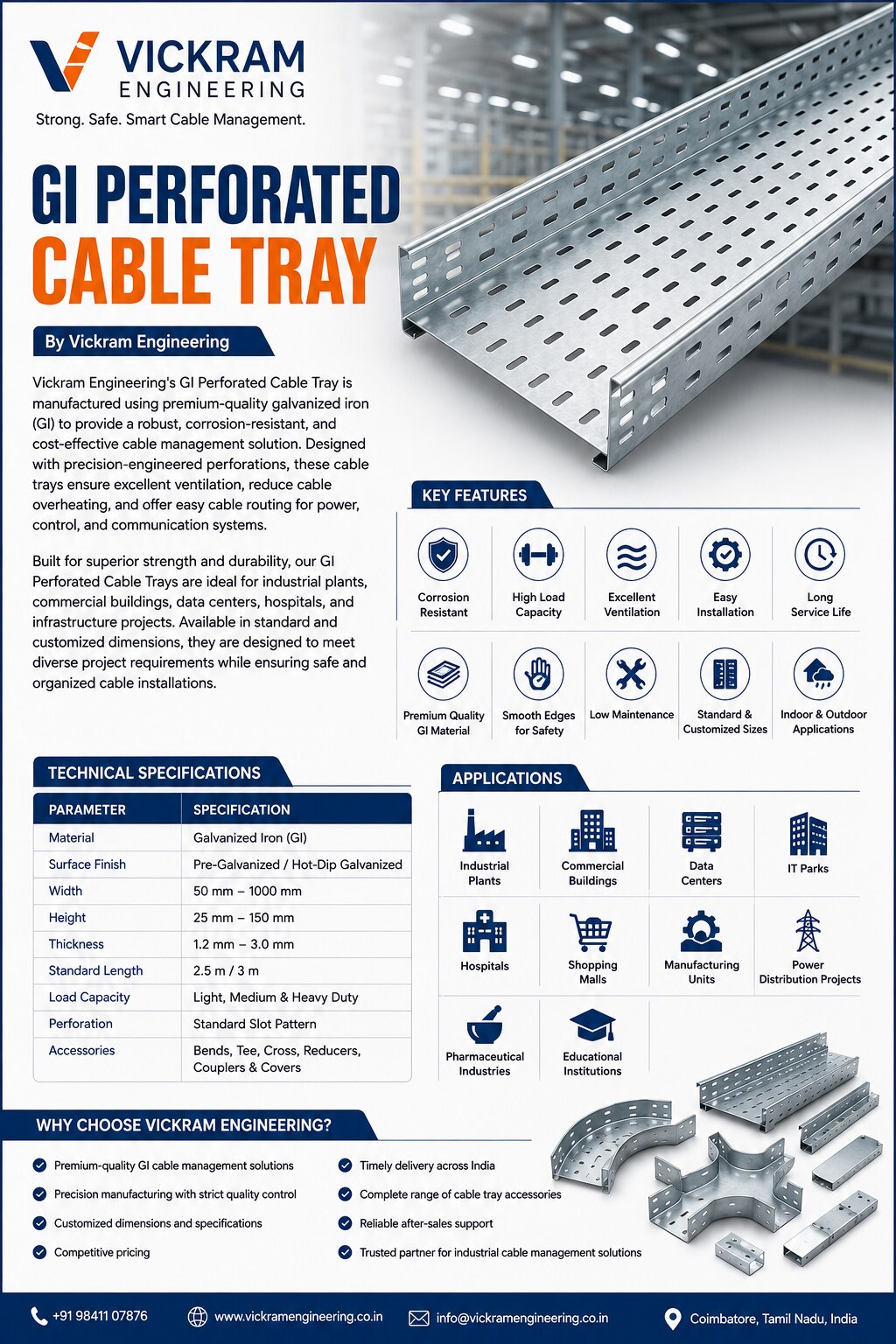 | GI Perforated Cable Tray Vickram Engineering's GI Perforated Cable Tray is manufactured using premium-quality galvanized iron (GI) to provide a robust, corrosion-resistant,... View product → |
Keywords