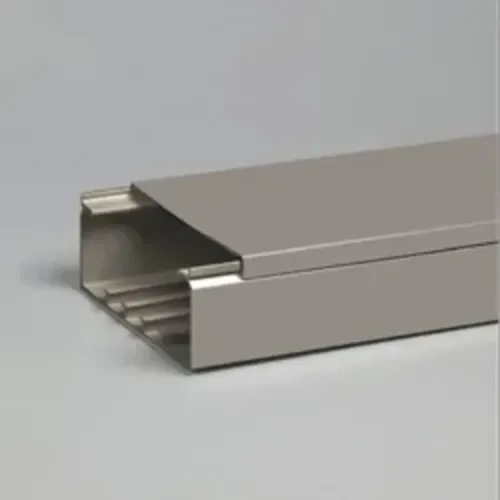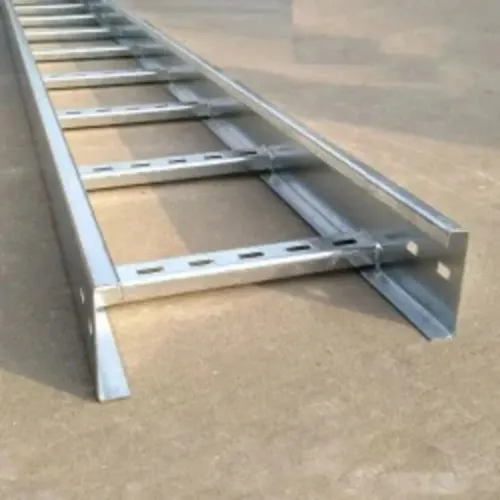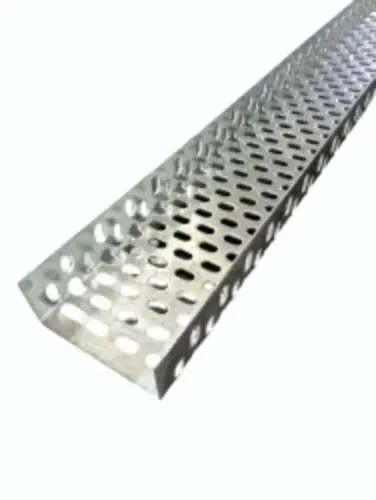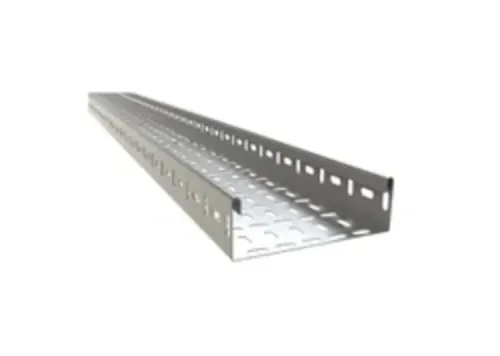
Bengaluru’s monsoon puts cable routes through wind-driven rain, splashback, wet dust, mud deposits, high humidity and repeated wet-dry cycles. By the end, you will be able to match a covered raceway to its location, specify a meaningful protection level and check the fittings, drainage, materials and maintenance details that determine whether the installation survives the season.
Key takeaways
- Use a fully enclosed, tested system for rooftop and exposed outdoor runs.
- Check the IP rating for the complete assembly, not the cover alone.
- Specify sealed fittings, cable entries, ends and drainage paths.
- Match material and finish to corrosion, heat and thermal movement.
Start with the exposure: where will the covered raceway run?
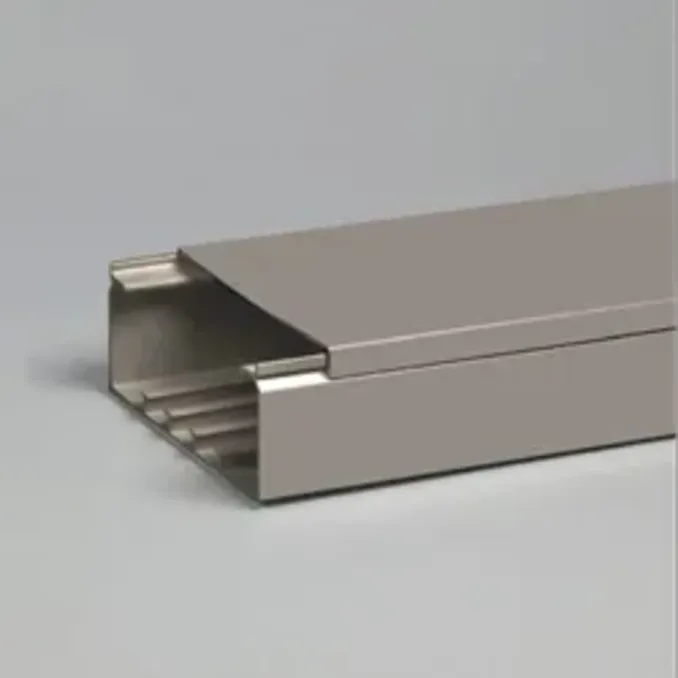
A covered raceway suits a dry plant room or protected utility corridor, but a rooftop, external wall or fully exposed outdoor run needs a fully enclosed, tested system. Do not choose from the product name alone.
Classify the route before selecting the product:
- Dry indoor: plant rooms with no wash-down and no outdoor air exposure.
- Humid indoor: utility corridors affected by condensation or temperature changes.
- Sheltered outdoor: semi-open loading bays or covered parking structures.
- Intermittent rain exposure: external walls and parking edges reached by wind-driven rain.
- Direct rain exposure: rooftops and fully exposed outdoor runs.
| Location | Main exposure | Initial decision |
|---|---|---|
| Indoor plant room | Humidity and temperature cycling | Covered raceway can suit |
| Protected utility corridor | Limited rain, maintenance access | Covered raceway can suit |
| Loading bay or parking structure | Wind-driven rain and splashback | Require sealed joints and tested protection |
| External wall | Side-entry rain and sunlight | Prefer a fully enclosed, UV-specified system |
| Rooftop or exposed run | Direct rain, UV, splash and wet-dry cycling | Require a fully enclosed, tested system |
Wind-driven rain enters from the side, while splashback carries mud and wet dust upward from floors, vehicle paths and roof edges. High humidity and temperature changes create condensation without rainfall; repeated wet-dry cycles concentrate dirt at covers, joints and low points.
Your quotation or drawing must state the exposure location, sunlight level, rain direction, splash risk, maintenance access and whether the route crosses a wash-down area. Use “monsoon suitable” only after recording these conditions for cable raceways with covers for monsoon in bengaluru.
Read the IP code as an assembly requirement, not a cover claim
Treat the IP code as a rating for the complete installed assembly, not as proof supplied by a cover. Under IEC 60529, the first digit addresses solids and the second addresses water; IP55 means dust-protected and protected against water jets, not temporary immersion.
Specify the protection this way:
1. Ask for test evidence showing that the stated IP rating applies to the assembled system under defined conditions, not only to a straight body or cover.
2. Require evidence covering the body, cover, joints, end caps, bends, tees, reducers, fasteners, cable entries and wall penetrations. A cover alone does not establish weather protection.
3. Inspect the cover-to-body fit, gasket material, joint overlap, captive fasteners or positive latches, and the treatment of raceway ends. Open ends and loose covers defeat cable raceway weather protection in bengaluru.
4. Specify sealing plates, correctly sized glands, grommets or downward-facing protected transitions at cable entries. Do not leave oversized knockouts or open conduit ends.
5. Require UV stabilisation for polymer raceways exposed to sunlight. UV resistance is separate from rain protection, even when the nominal IP rating is adequate.
6. Plan high-point entries, protected joints and a low-point drainage route. An IP spray test does not cover condensation from humid air or temperature cycling.
Drilling drain holes can improve evacuation, but it can invalidate the published rating unless the manufacturer approves their position and construction. Record that approval in the specification for a covered cable raceway in Bengaluru.
Detail the weak points: fittings, entries, ends and drainage
Driven rain enters at fittings and entries, not only along straight lengths. For cable raceway weather protection in Bengaluru, treat every tee, bend, reducer, expansion joint, end and wall transition as part of the enclosure.
1. Inspect each fitting for a continuous gasket, overlapping cover, sealed coupling or manufacturer-approved closure. A loose industrial cable raceway cover can shift under wind, vibration or maintenance and admit water.
2. Seal every entry with a correctly sized gland, sealing plate or grommet. Reject open conduit ends, oversized knockouts, unsealed gland plates and poorly fitted grommets; each exposes cables to driven rain, dust and mud.
3. Put cable entries high on vertical sections where the route permits. On exposed walls, use a downward-facing protected transition instead of an upward-facing opening that collects rain.
4. Give water a deliberate exit at every low point without washing mud across cable surfaces. Ask whether drain openings are factory-provided, how insects and dust are excluded, and whether the openings change the declared IP rating. Never trap cables in a sealed low point where condensate remains after rainfall.
5. Mark high points, low points and drain locations on the installation drawing. After each cable addition, restore gasket compression, cover alignment and specified fastener torque, then inspect every joint before the next monsoon.
Keep replacement gaskets in stock and confirm the supplier’s tightening method. An IP claim can fail after field cutting, drilling or a missing seal, even when the original assembly passed its test.
Choose the material and finish for corrosion, heat and movement
For Bengaluru’s wet-dry cycles, hot-dip-galvanized (HDG) steel is the robust default when mechanical strength matters; aluminum reduces weight, while stainless steel or a UV-rated polymer suits specific chemical or insulation needs. Choose against the actual exposure, support span and maintenance access.
| Material | Corrosion and maintenance | Weight and strength | Heat and movement |
|---|---|---|---|
| HDG steel | Zinc gives sacrificial protection; repair exposed steel after cutting or scratching | Heavier and stronger; verify anchors and supports for wind and maintenance loads | Lower expansion than aluminum; provide expansion joints on long outdoor runs |
| Aluminum | Resists atmospheric corrosion but needs isolation from galvanized steel in wet joints | Light, but check dent and span resistance | Higher thermal movement; use the manufacturer’s joint arrangement |
| Stainless steel or UV-rated polymer | Stainless suits aggressive exposure; polymer avoids galvanic contact but needs UV and impact verification | Stainless is strong; polymer is light but less rigid | Confirm operating-temperature limits and movement details |
Do not accept “galvanized” as a finish. For HDG components, specify ISO 1461 or an equivalent requirement, coating designation or thickness, and whether each part is pre-galvanized or hot-dip galvanized after fabrication. Require cut-edge treatment and the approved zinc-rich repair method for scratches and drilled holes.
Specify compatible fasteners, washers and isolation where aluminum meets galvanized steel; wet contact can create galvanic corrosion. A covered raceway reduces ventilation, so recalculate fill, grouping factors and conductor temperature using the cable manufacturer’s data rather than open-tray ampacity.
Bond an industrial cable raceway cover with jumpers or tested conductive joints where protective bonding or electromagnetic shielding depends on continuity.
Turn the decision into a purchase and inspection specification
Put the performance requirements in the quotation before you compare prices. For a covered cable raceway in Bengaluru, state whether the route is indoors, sheltered outdoors or directly exposed, then specify the target IP code under IEC 60529 rather than “rainproof” or “monsoon-proof.”
Request these fields in every supplier’s offer:
- Location and exposure; target IP code; UV stabilisation requirement; material and corrosion finish
- Operating-temperature range, cable fill percentage, grouping, ventilation and heat-dissipation assumptions
- Cover retention under wind, vibration and repeated maintenance, using captive fasteners, positive latches or bolted joints where exposure demands it
- Drain openings, insect and dust control, bonding or earthing method, and compatibility with trays, brackets, anchors and supports
- The effect on the IP claim after field cutting, drilling, cable additions or gasket replacement
For cable raceways with covers for monsoon in Bengaluru, compare evidence rather than labels:
| Requirement | Acceptable comparison evidence | Reject or query |
|---|---|---|
| Complete assembly | Drawings and test evidence for body, cover, joints, fittings, entries and penetrations | Rating supplied for the cover alone |
| Installed route | Straight sections, bends, tees, reducers, end caps, expansion joints and wall penetrations shown together | Straight-length drawing only |
| Supplier capability | Route review, matched fittings and documented conditions; Vickram Engineering is useful when it provides this work | Product name without installation review |
Before handover, inspect cover alignment, gasket continuity, fasteners, cut-edge repairs, entry seals, drains, bonding jumpers and separation between power, control, instrumentation and data circuits. Keep the signed record and replacement-gasket details for the next monsoon maintenance cycle.
Related products
 | Aluminum Cable Raceway By Vickram Engineering Aluminum Cable Raceway from Vickram Engineering is designed to provide a safe, organized, and durable cable management... View product → |
 | Cable Raceway Systems The GI Raceway with Cover is a premium cable management solution designed to provide complete protection and organized routing of electrical,... View product → |
Frequently asked questions
Where can covered cable raceways be used during Bengaluru monsoon?
A covered raceway suits dry plant rooms and protected utility corridors. Use a fully enclosed, tested system for rooftops, exterior walls and fully exposed outdoor runs.
Does a cable raceway cover prove weather protection?
No. Read the IP code for the complete installed assembly, including the body, cover, fittings, entries and ends. A cover alone does not establish the enclosure rating.
Which raceway points need inspection for rain and dust entry?
Inspect joints, fittings, cable entries, end closures and drainage paths. These weak points can admit water or dust even when the main raceway body is covered.
How should you choose the material and finish for an outdoor raceway?
Choose the material and finish for Bengaluru’s corrosion exposure, heat and thermal movement. Include those requirements in the purchase specification and verify them during inspection.
Related products
 | Galvanized Cable Tray Vickram Engineering's Galvanized Cable Tray is engineered to provide a strong, reliable, and corrosion-resistant cable support system for industrial,... View product → |
 | Ladder Type Cable Tray Product Description Vickram Engineering is a leading manufacturer and supplier of premium-quality Ladder Type Cable Trays designed for supporting and... View product → |
 | Fittings Vickram Engineering is a trusted manufacturer and supplier of high-quality cable trays designed for efficient cable management in industrial,... View product → |
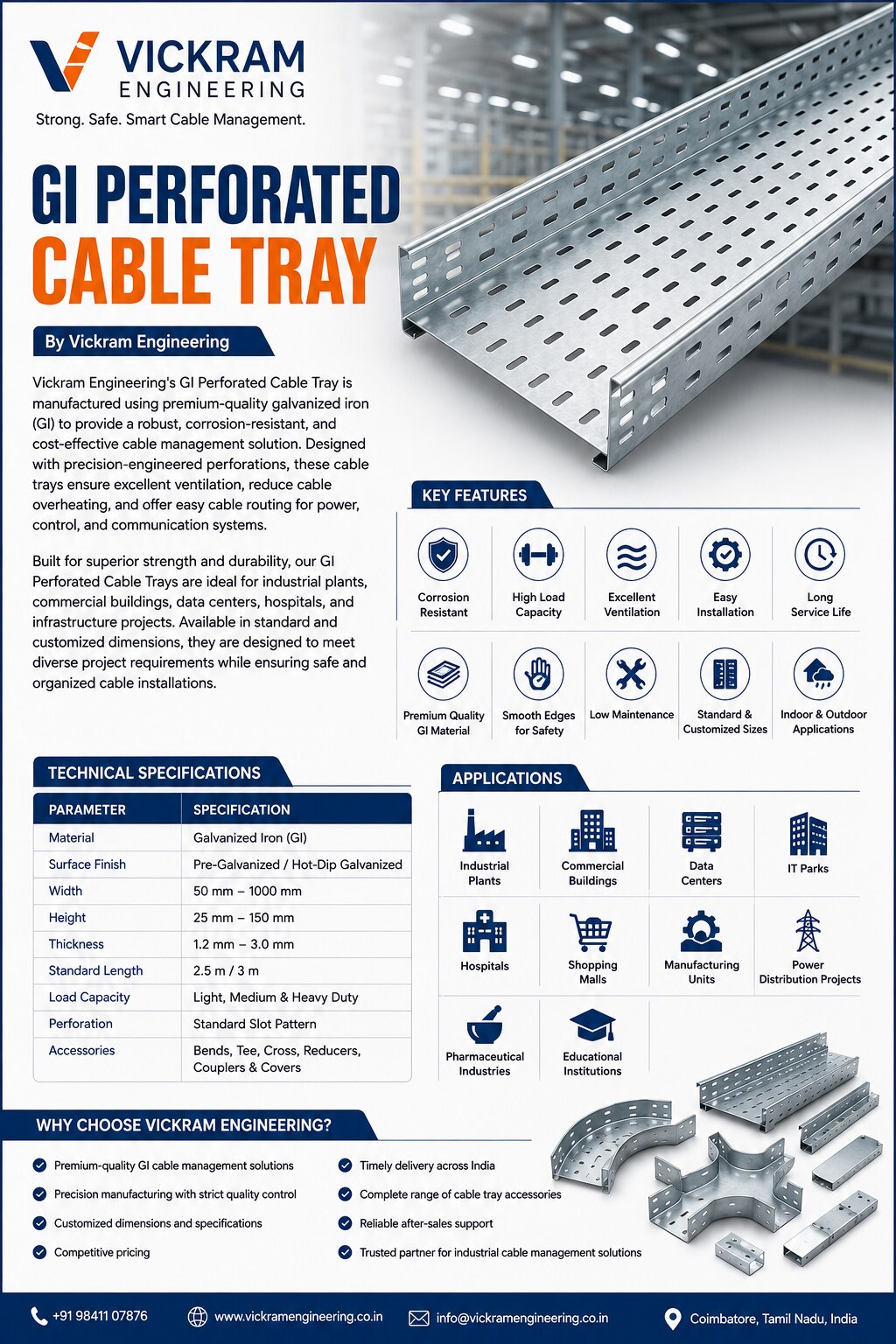 | GI Perforated Cable Tray Vickram Engineering's GI Perforated Cable Tray is manufactured using premium-quality galvanized iron (GI) to provide a robust, corrosion-resistant,... View product → |
Keywords